
Search New York Court Docket Records
New York court docket records are kept by County Clerks and court offices in all 62 counties. You can search for case filings, docket entries, and court records through state online portals or by visiting the courthouse in person. The New York State Unified Court System runs several free search tools that cover Supreme Court, County Court, Family Court, and Surrogate's Court cases. Each County Clerk serves as the main custodian of court docket records for their jurisdiction. If you need copies of specific filings or certified court documents, the County Clerk's office in the right county is where you start your search.
New York Court Docket Overview
Where to Find New York Court Docket Records
Court docket records in New York are held by County Clerks in each of the 62 counties. The County Clerk is the legal custodian of Supreme Court and County Court records under Judiciary Law § 255. That law says the clerk must keep and give access to all civil and criminal court files. Each clerk runs a records room where the public can look up docket entries, case filings, and judgment records in person.
The state court system has four main levels. The Court of Appeals sits at the top. Below that is the Appellate Division. Supreme Court handles major civil and criminal cases in each county. County Court deals with felony cases and civil claims up to $25,000. Family Court and Surrogate's Court each have their own set of docket records as well. Town and Village Courts handle minor matters at the local level. All of these courts produce docket records that track the life of a case from start to finish.
Under Judiciary Law § 4, court sittings in New York must be open to the public. Court records and docket books fall under this same rule of access. Courts are not subject to the Freedom of Information Law because Public Officers Law § 86 does not count them as agencies. Instead, the Judiciary Law controls how you get court docket records.
How to Search Court Docket Records Online
New York runs several free online tools for court docket searches. The main one is the eCourts system. It lets you look up case info, track cases, and view docket entries from many courts across the state.
The WebCivil Supreme portal covers civil Supreme Court cases in all 62 counties. You can search by index number, party name, attorney name, or justice. The system shows case status, appearance dates, and motion schedules. It gives you a full view of docket activity on any civil case filed in Supreme Court. A mobile version works on phones and tablets too.
The New York State Unified Court System provides access to court records through the Court Records Information page. This is the main starting point for anyone who wants to find court docket records in the state. The page explains how to use each online tool, what records are available, and how to make requests when online access falls short.
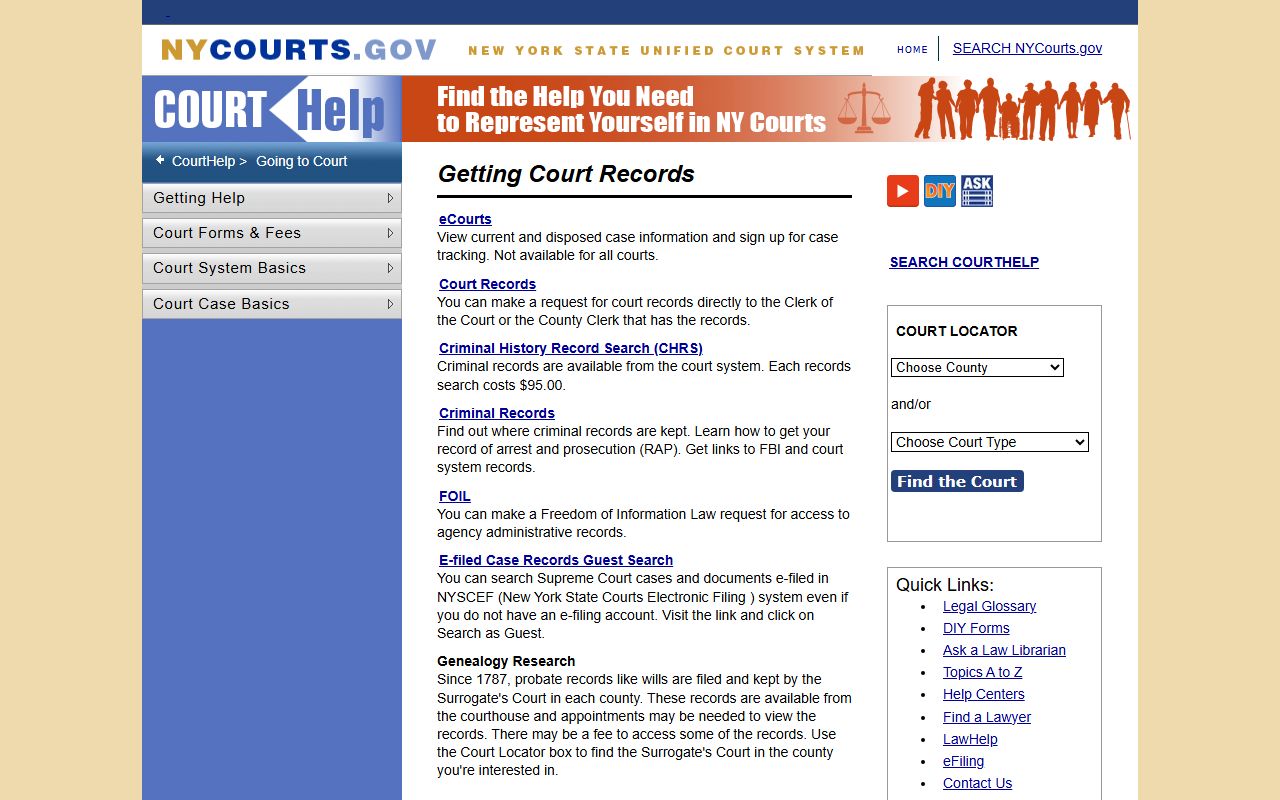
The court records page shows all the ways you can search for docket information in the New York State Unified Court System.
For criminal cases, the WebCriminal system shows pending cases in local and superior courts. It covers 13 counties for superior court cases and all of New York City for summons cases. You can search by case number, defendant name, or court calendar. Keep in mind that WebCriminal only has pending cases with future court dates. Disposed cases do not show up here.
The WebCivil Local system has case records from City Courts, District Courts, and some Town and Village Courts. It covers 61 City Courts, Nassau and Suffolk County District Courts, and New York City Civil Courts. Not every local court is in the system, so check the list of available courts first.
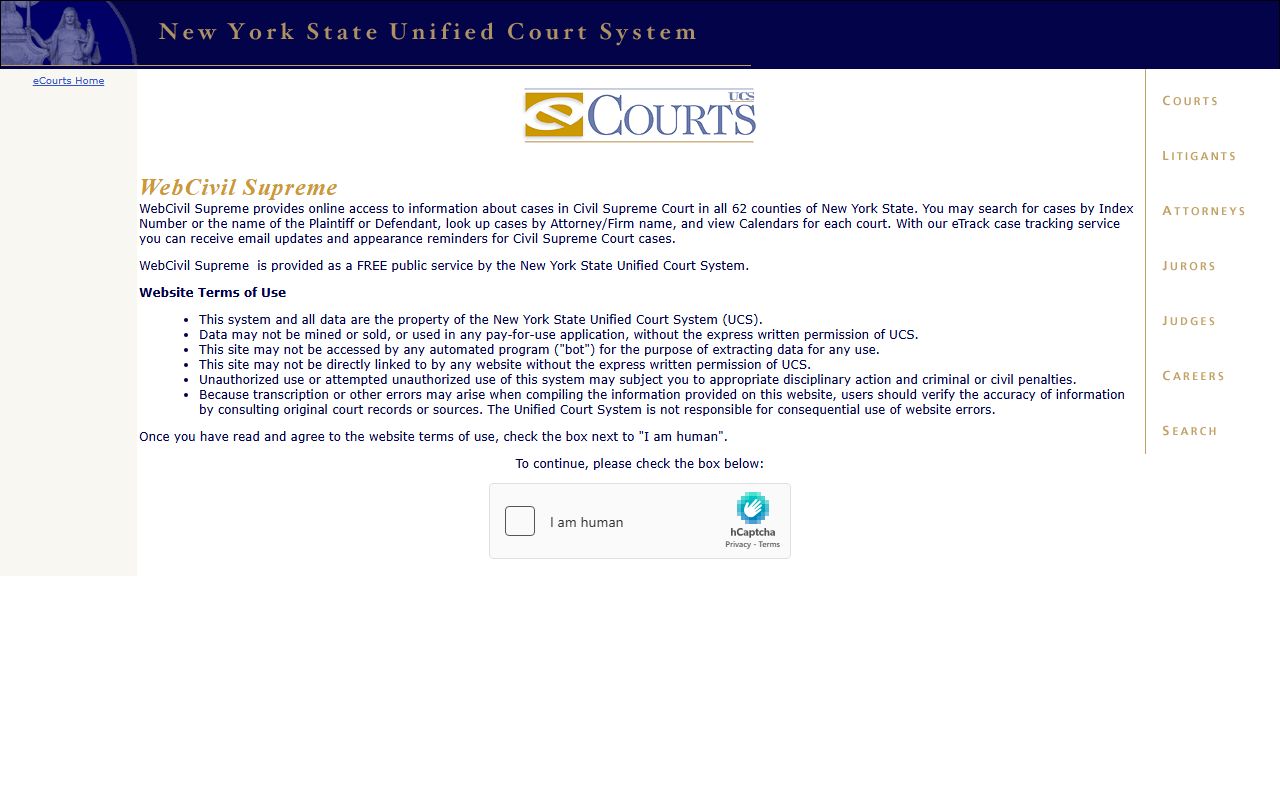
WebCivil Supreme lets you search civil case docket records across all 62 New York counties from one place.
New York Court Docket E-Filing System
The NYSCEF system is how attorneys and litigants file court documents in Supreme Court cases. Since December 26, 2022, e-filing is mandatory for all new civil Supreme Court cases statewide. The system accepts electronic signatures and gives confirmation of each filing. Every document filed through NYSCEF becomes part of the court docket.
You do not need an account to search NYSCEF. The Guest Search feature lets anyone look up cases and view public documents. Search by case number, party name, or attorney info. Some filed documents are available to view, though per-page fees may apply for downloads depending on the county. NYSCEF is one of the best ways to see recent docket activity on Supreme Court cases because filings appear quickly after submission.
Note: Judiciary Law § 255-b requires County Clerks to keep a docket book for each action where a Request for Judicial Intervention or appeal is filed, with a full record of all papers in the case.
More Court Docket Search Tools
The Criminal History Record Search is a statewide search run by the Office of Court Administration. It costs $95 per name and covers all 62 counties. Results include open and pending cases plus convictions. The search uses exact name and date of birth matches only. Results come back by email the next business day.
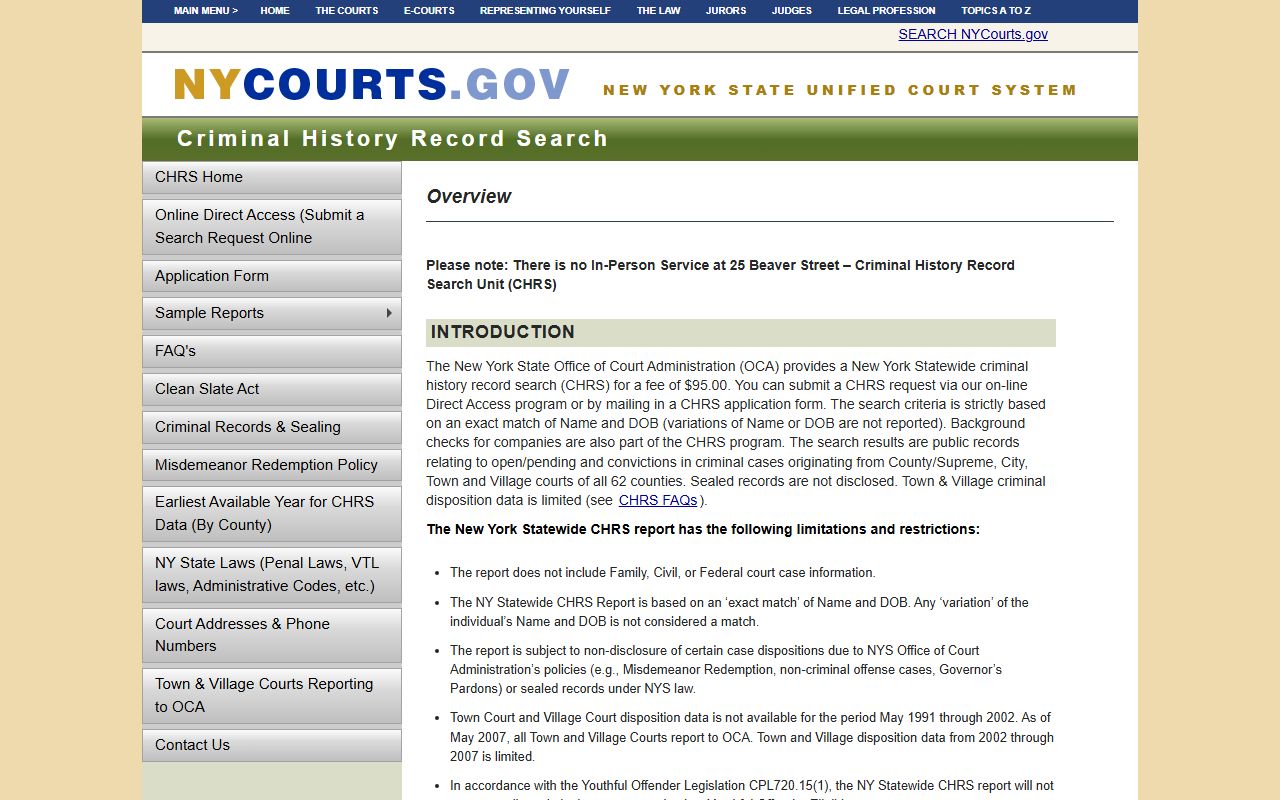
The CHRS portal lets you run a statewide search of criminal court docket records from all 62 New York counties.
The WebSurrogate system covers Surrogate's Court files across the state. You can search for probate records, estate proceedings, and wills. The system offers name searches, file searches, and access to old index book pages. Not all counties have all record types online, but it is a good starting point for estate-related court docket records.
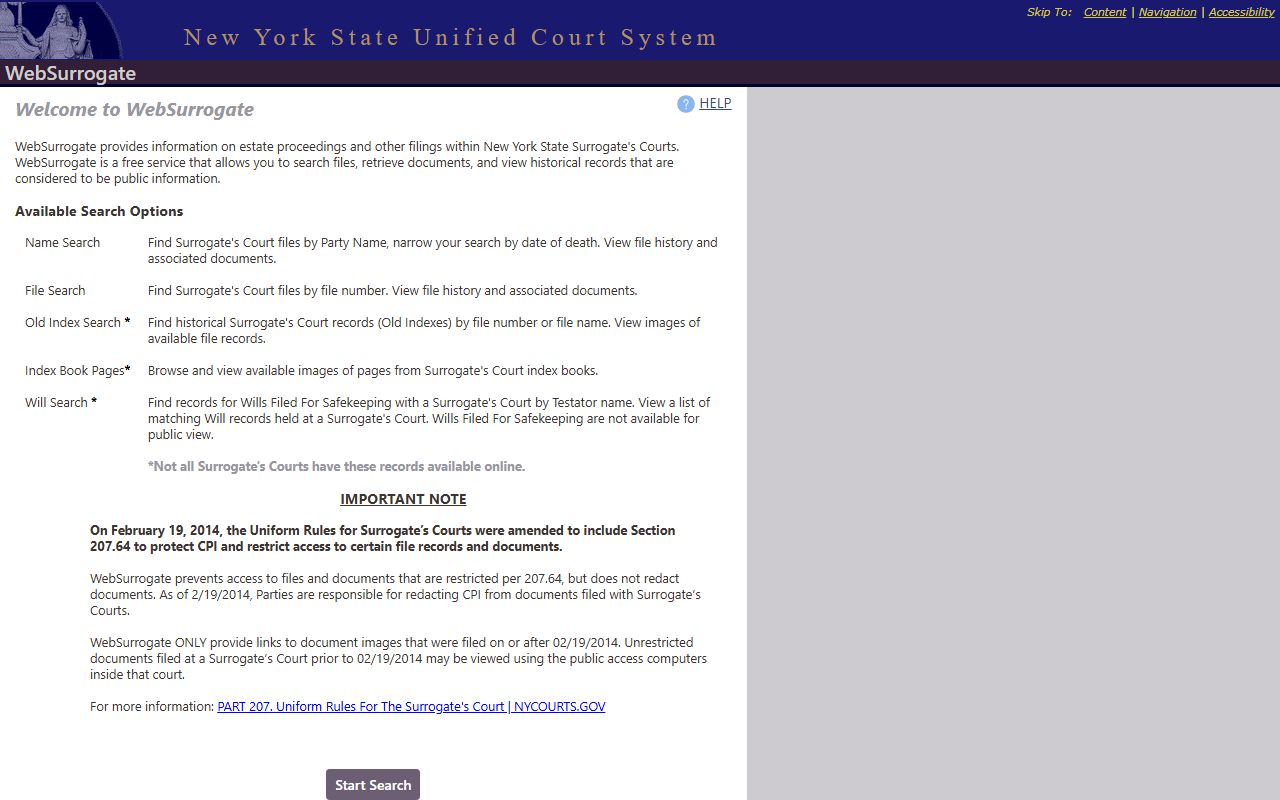
WebSurrogate gives free access to Surrogate's Court docket records including estate filings and probate cases.
The NYS Division of Corporations keeps business entity records. These are often tied to court docket records when lawsuits name a business. You can search for corporations, LLCs, and other entities by name. UCC filings can be searched by debtor name or file number. Basic search results are free.
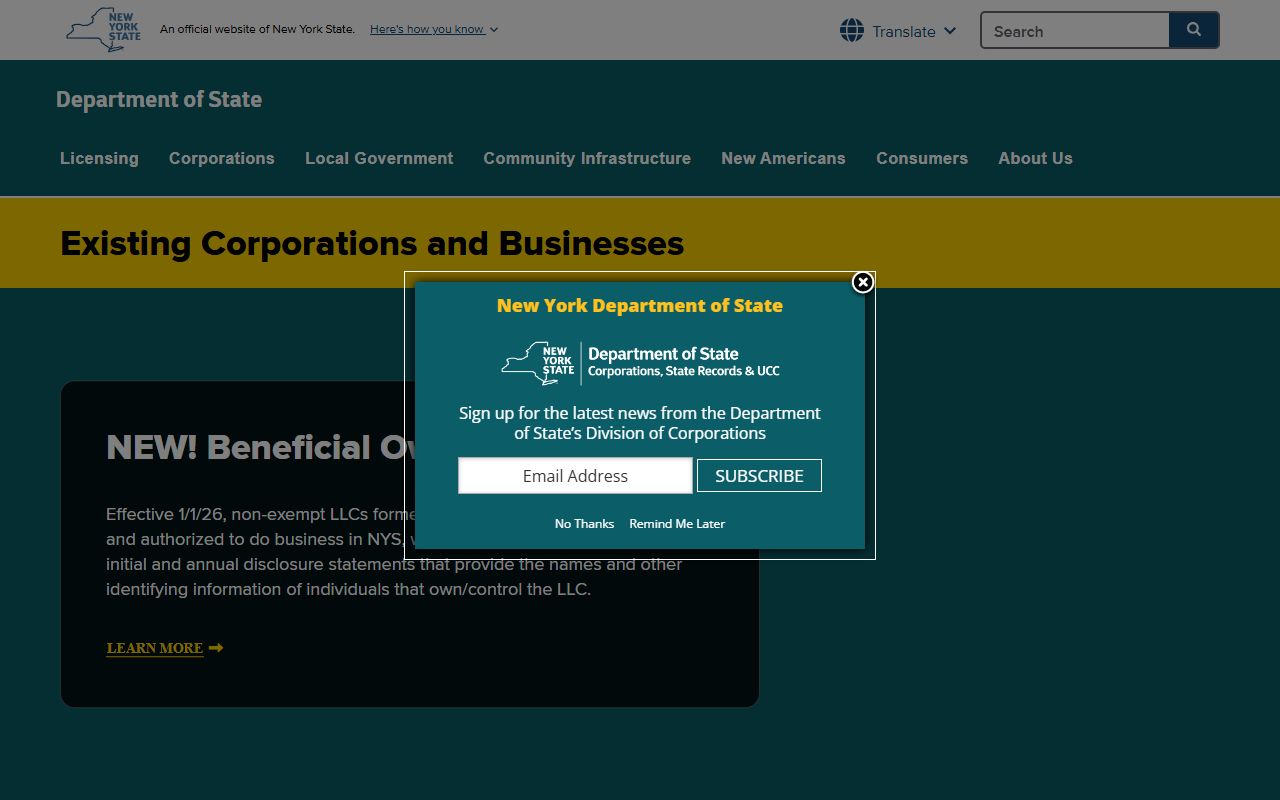
Business entity records from the Division of Corporations often come up in civil court docket cases across New York.
Court Docket Record Fees in New York
Fees for court docket records vary by county and document type. There are some standard rates set by state law.
An index number for a new Supreme Court case costs $210. Filing a notice of motion runs $45. A subpoena costs $40. These are the basic court filing fees that create new docket entries. CPLR § 8019 sets fee standards for Town and Village Courts. Most County Clerk offices charge $0.65 per page for plain copies of court docket records. Certified copies cost $6 for the first page and $1.25 for each page after that. A record search runs $5 per name for each two-year period searched.
Some counties charge less. Onondaga County, for example, charges just $0.25 per page for standard copies. Saratoga County also keeps copy fees around $0.25 per page. Erie County charges $0.65 per page for uncertified copies and $5.00 for certified copies. Always call the County Clerk before you go to confirm what they charge. Fees can change, and some offices only take certain forms of payment like money orders or certified checks.
Note: Queens County requires separate money orders for each two-year search period and does not accept personal checks for court docket record requests.
How to Get Court Docket Copies
Visit the County Clerk in the county where the case was filed. Bring the case index number if you have it. Staff can pull up the file and make copies while you wait. You can also search by party name if you do not have the case number. Most offices are open Monday through Friday during business hours.
Many County Clerks accept mail requests too. Send a written request with the case details, a check or money order for the fees, and a self-addressed stamped envelope. In-person requests are usually handled the same day. Mail requests can take a week or more depending on how busy the office is. Some counties also accept requests by fax or email.
For court docket records in New York City, each borough has its own County Clerk. Manhattan cases go through the New York County Clerk at 100 Centre Street. Brooklyn cases go to the Kings County Clerk at 360 Adams Street. Queens cases go to 88-11 Sutphin Boulevard in Jamaica. Bronx cases are handled at 851 Grand Concourse. Staten Island cases go to 130 Stuyvesant Place.
Are Court Docket Records Public in New York
Yes. Court docket records in New York are public. Judiciary Law § 4 says all court sittings must be open. Sections 255 and 255-b say County Clerks must keep docket books available for the public. You do not need to be a party to the case. You do not need to give a reason for your request. Walk in, ask, and the clerk will help you find what you need.
Some records have limits. Sealed cases are off limits. Youthful offender records stay closed. Family Court records have strict rules about who can see them. Certain financial documents in civil cases may be restricted. But the vast majority of court docket records in New York are fully open to anyone who asks. The strong presumption under New York common law is that the public has a right to see court records and proceedings.
Browse New York Court Docket Records by County
Each of New York's 62 counties has a County Clerk who keeps court docket records for that area. Pick a county below to find contact info, fees, and local search options.
Court Docket Records in Major New York Cities
Court docket filings go through the County Clerk in whatever county the city is in. Pick a city below to find out where to search for court docket records in that area.